
Home
A comprehensive resource for safe and responsible laser use

How to reduce incidents: For the FDA/CDRH (and other regulators)
The FDA’s Center for Devices and Radiological Health is the U.S. government agency in charge of laser equipment safety. CDRH regulations include mandated safety labels which describe the type and power of laser, the classification and the nature of the hazard. These are the ubiquitous “Caution” and “Danger” labels that should be on every laser device emitting hazardous beams:
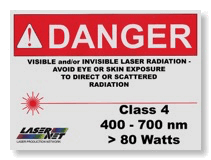
Label from a powerful Class 4 laser, over 80 watts. This is from a light show laser used by Laser Production Network of Miami, Florida.
Mandatory Aviation Safety Label
Unfortunately, these labels only cover eye and skin hazards. They do not address eye-safe but too-bright light aimed at pilots. Given the widespread misuse of lasers with aircraft, it is clear that existing labels do not provide adequate information for users.
To further its mission of public health safety, CDRH should require a new Aviation Safety Label. This would have a statement such as “DO NOT aim at or near aircraft.” Additional information can also be added, depending on the size available for the label. Here is a sample:

In February 2012, we made detailed suggestions to a safety standards group, discussing what should be on an Aviation Safety Label. That document is here.
Adding such a label should not be a problem for manufacturers. Lasers are already required to have labels; one more does not add a significant cost or burden. ILDA already recommends for manufacturers that they voluntarily add a warning about not hitting aircraft, and in September 2009 a major Internet laser distributor did just that.
Details about what lasers should have the label, and about the exact wording, can be worked out. As of August 2009, ILDA is working on a formal proposal to CDRH. Ideally, the label idea will first be implemented as guidance, in the form of a “Laser Notice” recommendation to laser manufacturers and sellers. If the label becomes widespread and helps reduce the number of incidents, this would be great. But if manufacturers and sellers resist a voluntary approach, then CDRH should begin rulemaking proceedings, to make such a label mandatory.
Limitations on handheld lasers’ power
In our opinion, restrictions on handheld lasers may be justified due to the current problem with aircraft illuminations. Efforts to solve the problem through enforcement and publicity do not appear to be working. As of mid-2011, the numbers of illuminations continue to rise.
We also believe that restrictions are NOT justified based on the very few injury reports, or based on non-aviation laser harassment of vehicles or persons. (There may be exceptions in areas such as Ocean City NJ and Ocean City MD. These are resort towns where easy availability has led to numerous laser harassment complaints, as well as some aircraft illuminations.)
Any tax, ban or licensing regulations would need to be based on FDA’s true regulatory authority, not on incorrect interpretations of their existing authority. If new authority is needed, for example from Congress, FDA should work to obtain this authority.
Finally, any laser restrictions also would need to accurately define what lasers are affected, and avoid loopholes. Additional information is on the “If you are writing a laser law” page.
For more information about the CDRH, see this page.