
Home
A comprehensive resource for safe and responsible laser use

How to reduce incidents
Everyone involved with lasers -- users, sellers, pros, pilots, airlines and regulators -- can help reduce the number and severity of laser pointer incidents. In our opinion, no single change will be a “magic solution.” Therefore, we have listed a number of recommendations for various interested groups. Click on the links below for more details.
- Our recommendations: A link to our page What should be done about laser pointers? which has detailed recommendations.
- For laser pointer users: Don’t point at aircraft or vehicles. Don’t annoy people. Tell your friends and associates. Don’t aim at “stars”, circle them instead. Don’t buy a laser pointer more powerful than you really need for outdoor use.
- For laser pointer sellers: Include a “Caution” sheet with every order. Put a permanent label warning against aiming at aircraft, on every laser pointer above 5 mW. Help form a trade association for laser pointer manufacturers, distributors and sellers. Get involved in regulations and SAE G-10T.
- For professionals using lasers outdoors, such as observatories, remote sensing, and laser light shows: Use aircraft spotters and automated/semi-automated systems as appropriate.
- For pilots: Learn how to recognize and recover from an incident. Do not panic. Report an incident. Seek qualified eye care if needed.
- For airlines and the FAA: Provide mandatory pilot training.
- For the FDA’s Center for Devices and Radiological Health: Suggest or mandate warning labels on lasers with visible beams. Consider restrictions or a ban on consumer sales of higher-powered lasers.
- If lasers need to be restricted, one possible method is to tax handheld lasers.
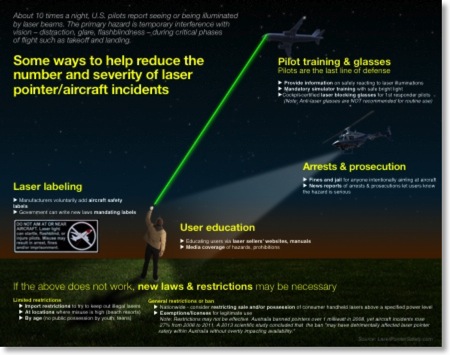
This diagram shows various ways to help reduce laser pointer incidents. Click to enlarge.