
Home
A comprehensive resource for safe and responsible laser use

Tips for star pointing with lasers
There are at least two potential non-decorative consumer uses for lasers outdoors, pointing out stars in the sky and dispersing birds. This page discusses star-pointing with lasers.
Summary
Using a laser for star-pointing needs to be done with caution. It is an application that requires relatively strong lasers, so that viewers can see the beam shaft (not just the end dot). Further, the beam is aimed at glowing objects in the sky. Because these glowing, point-like objects could be aircraft, outdoor laser users need to be careful.
Safe use for astronomy education
Don’t point; circle instead
Aircraft at a distance can look like stars. This is especially true if they are moving directly towards you, since there will be little apparent motion against the sky.
For this reason, NEVER point directly at a dim or unknown “star”. Instead, move the beam in a circular motion around the object. When doing the circular motion, or when “drawing out” a constellation, keep the beam moving and keep it away from any “stars” since they may be aircraft.
Use sparingly
Use the laser only long enough to point out the object. Once it is identified, leave the laser off. (After all, this is how people observed the sky for thousands of years, before laser pointers were invented!)
The beam does NOT end!
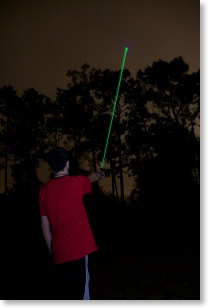
This unretouched photo shows how a beam outdoors can seem to end after only a few hundred meters. This is a potentially dangerous illusion, as described here. The beam actually continues to travel -- even though the viewer can no longer see the light scattered back to them.
In Feb. 2011, a 14-year-old boy was arrested for illuminating an aircraft on approach to Los Angeles International Airport. He told police that he thought the beam “would not go up to the height of the aircraft.” He was wrong, of course.
Instead of a few hundred feet, a beam can be a hazard to pilots miles away. For example, even a relatively weak U.S.-legal 5 mW laser pointer is a distraction hazard to pilots over two miles away. The more powerful beam in the photo can cause serious glare (the pilot can’t see past the light) two miles away, while the distraction hazard is 22 miles!
Therefore, ALWAYS act as if the beam continues on, forever. Don’t let the beam get close to any aircraft or unknown star along either the visible beam path OR its non-visible continuation.
(Quick explanation of the illusion: There are two effects happening. One is that at some point, the beam exits the dustier part of the atmosphere. This means much less light is reflected back. You can no longer see the beam when it is in cleaner air, higher up. The other effect is that while the beam is slowly spreading out, perspective -- like train tracks appearing to converge far away -- counteracts this, so the beam appears as if it is always parallel. An “infinitely parallel” line is unfamiliar to our visual system. We therefore misjudge the beam’s length; a beam that can be seen miles away may appear to the laser owner as if it is only a few hundred feet long.)
Select green
For star pointing, green is best. The human eye sees green much better than the same amount of red or blue, so a 5mW green laser appears to be 5 to 10 times brighter than a 5mW red laser.
Looking at a green beam in the sky should not adversely affect night vision. To keep your night vision, avoid looking directly at the laser dot on a nearby or light-colored surface.
5 mW works fine
In some jurisdictions, there are limits on laser power. For example, in the U.K. it is not allowed to sell laser pointers over 1 mW. In the U.S. it is not permitted to sell lasers for pointing applications over 5 mW. You may be restricted, therefore, in the laser pointers which are available to you.
However, you may be in a country without laser restrictions. Or you may obtain a laser which was not sold or intended for pointing but which nevertheless could be used outdoors. The question then is “how much power is needed?”
For yourself or a small group under most conditions, 5 mW is sufficient.
A 2010 study, “Green Laser Pointers for Visual Astronomy: How Much Power Is Enough?”, had 23 observers adjust the power of a 532 nm green laser beam “propagating skyward through the atmosphere in a heavily light-polluted urban setting.” The lowest power where the beam could clearly be seen was between 1.4 and 5.6 milliwatts. The average of all powers chosen was 2.4 milliwatts. The authors concluded that “Green laser pointers with output powers below 5 mW (laser classes American National Standards Institute 3a or International Electrotechnical Commission 3R) appear to be sufficient for use in educational nighttime outdoors activities, providing enough bright beams at reasonable safety levels.”
Here is one user’s description of the visibility of his 4.92 mW laser pointer:
- “The first time I used it, I was in a rural area, although not very far from the city, and there was a setting gibbous moon. Limiting magnitude was around 5.0, maybe 5.5. The laser was bright and easy to see.... can you see it from a dark spot in the worst light-polluted sky imaginable? Yes, you can see it. Just for perspective, I used it about 45 minutes after sunset. The sky was still quite bright, with 20 minutes of nautical twilight left, and an hour of astronomical twilight. Limiting magnitude was perhaps 3.5. The beam was visible in these conditions. Dim, but unmistakably visible.”
For a larger group, or where the air is especially clean and dry, slightly higher power such as 10 to 25 mW will be better. The absolute limit for this application should be about 50 mW. There is no objective reason to need more than 50 mW for astronomical pointing applications.
Tips and resources from astronomers
The Royal Astronomical Society of Canada has produced a webpage with information and recommendations on green laser pointer usage. At the bottom of the RASC webpage are additional resources such as a brochure, poster and PowerPoint presentation.
The Astronomical Society of South Australia has a similar document, Guidelines for the Safe Use of Hand Held Laser Pointers in Astronomy. It includes a form “to assist the police or other enforcement Agencies” by providing evidence of membership in the ASSA; the form should be carried by ASSA members “at all times when the laser pointer is in their possession.”