
Home
A comprehensive resource for safe and responsible laser use
US: Bakersfield (Ca.) paper advocates restrictions on purchasing laser pointers
13 Apr 2019 -- Categories: Bans & Restrictions | Easy availability | Ways to reduce incidents | SLA news
An April 13 2019 editorial in the Bakersfield Californian about laser pointers says that "It's time to get serious about this serious danger."
The paper suggests requiring retailers to restrict access, putting them in a cage or behind a counter in order to "take away the 'anonymous' nature of the purchase and drive home the serious concerns about their use.
From the Bakersfield Californian. The paper also ran a news story April 11 2019 about the hazards of laser pointer misuse against aircraft.
The paper suggests requiring retailers to restrict access, putting them in a cage or behind a counter in order to "take away the 'anonymous' nature of the purchase and drive home the serious concerns about their use.
From the Bakersfield Californian. The paper also ran a news story April 11 2019 about the hazards of laser pointer misuse against aircraft.
US: FAA warns against aiming holiday lasers into the sky
The following is from a December 12 2018 news release by the U.S. Federal Aviation Administration:
With the holiday season upon us, the Federal Aviation Administration (FAA) wants to make sure your laser-light displays are aimed at your house and not into the sky.
Each year we receive reports from pilots who are distracted or temporarily blinded by residential laser-light displays. You might not realize this, but a well-meaning attempt to spread holiday cheer has the potential to create a serious safety risk to pilots and their passengers flying overhead.
So please make sure all laser lights are directed at your house and not into the sky. The extremely concentrated beams of laser lights reach much farther than you might realize.
If we become aware that your laser-light display affects pilots, we’ll ask you to adjust them or turn them off. If your laser-light display continues to affect pilots, despite our warnings, you could face a civil penalty.
Laser strikes against aircraft continue to increase each year. Last year we received 6,754 reports of laser strikes against aircraft, a 250 percent increase since we started tracking laser strikes in 2010.
Intentionally aiming a laser at an aircraft is a serious safety risk and violates federal law. Many high-powered lasers can completely incapacitate pilots who are trying to fly safely to their destinations and may be carrying hundreds of passengers.
We work with federal, state, and local law enforcement agencies to pursue civil and criminal penalties against individuals who purposely aim a laser at an aircraft. We may impose civil penalties of up to $11,000 per violation. Civil penalties of up to $30,800 have been imposed by the FAA against individuals for multiple laser incidents.
With the holiday season upon us, the Federal Aviation Administration (FAA) wants to make sure your laser-light displays are aimed at your house and not into the sky.
Each year we receive reports from pilots who are distracted or temporarily blinded by residential laser-light displays. You might not realize this, but a well-meaning attempt to spread holiday cheer has the potential to create a serious safety risk to pilots and their passengers flying overhead.
So please make sure all laser lights are directed at your house and not into the sky. The extremely concentrated beams of laser lights reach much farther than you might realize.
If we become aware that your laser-light display affects pilots, we’ll ask you to adjust them or turn them off. If your laser-light display continues to affect pilots, despite our warnings, you could face a civil penalty.
Laser strikes against aircraft continue to increase each year. Last year we received 6,754 reports of laser strikes against aircraft, a 250 percent increase since we started tracking laser strikes in 2010.
Intentionally aiming a laser at an aircraft is a serious safety risk and violates federal law. Many high-powered lasers can completely incapacitate pilots who are trying to fly safely to their destinations and may be carrying hundreds of passengers.
We work with federal, state, and local law enforcement agencies to pursue civil and criminal penalties against individuals who purposely aim a laser at an aircraft. We may impose civil penalties of up to $11,000 per violation. Civil penalties of up to $30,800 have been imposed by the FAA against individuals for multiple laser incidents.
US: FAA credits "heightened public awareness" for lowering laser incident numbers in 2017 and 2018
An April 11 2019 news item from the U.S. Federal Aviation Administration says that "Heightened public awareness of the serious safety risk posed by lasers reduced the total number of laser strikes for the second consecutive year…."
Incidents reported to FAA have declined from 7,398 reports in 2016, to 6,754 reports in 2017, and 5,663 reports in 2018, the last full year for which statistics are available.
According to FAA, "the agency and law enforcement agencies are working hard to increase public awareness of the dangers posed by lasers."
The news item linked to a page entitled "Laser Incidents and Legal Interpretation of the Law", a new video published April 10 2019 on YouTube, entitled "Laser Strikes on Aircraft Pilots", and an April 10 2019 Fact Sheet on lasers.
One paragraph of the fact sheet says that "The FAA’s guidance for agency investigators and attorneys stresses that laser violations should not be addressed through warning notices or counseling. The agency seeks moderately high civil penalties for inadvertent violations, but maximum penalties for deliberate violations. Violators who are pilots or mechanics face revocation of their FAA certificate, as well as civil penalties."
From FAA news item "Outreach Helps Bring Laser Strike Numbers Down"
COMMENTARY FROM LASERPOINTERSAFETY.COM:
We are not aware of any recent (2015-2018) campaign by FAA to increase public awareness.
In 2014, there was a publicity campaign by the Federal Bureau of Investigation (FBI) in 12 U.S. cities between February 11 and April 11 2014, which offered a $10,000 reward for information about anyone pointing a laser at an aircraft. This was expanded nationwide between June 3 and September 1 2014. During 2014 there was a 12.8% decline in laser incidents compared to 2013. It is not known how much the FBI publicity campaign contributed to the decline.
In our view, there may be other reasons for the decline. For example, pilots may be tiring of reporting laser illuminations with no apparent follow-up or effect. This would lead to a decline in reported incidents.
We are not aware of any studies done to determine the reasons for declines in reported laser incidents.
To summarize, it seems incorrect to attribute the lower number of laser incidents to "heightened public awareness." In fact, there is some anecdotal evidence that publicity actually leads to copycat laser incidents.
Incidents reported to FAA have declined from 7,398 reports in 2016, to 6,754 reports in 2017, and 5,663 reports in 2018, the last full year for which statistics are available.
According to FAA, "the agency and law enforcement agencies are working hard to increase public awareness of the dangers posed by lasers."
The news item linked to a page entitled "Laser Incidents and Legal Interpretation of the Law", a new video published April 10 2019 on YouTube, entitled "Laser Strikes on Aircraft Pilots", and an April 10 2019 Fact Sheet on lasers.
One paragraph of the fact sheet says that "The FAA’s guidance for agency investigators and attorneys stresses that laser violations should not be addressed through warning notices or counseling. The agency seeks moderately high civil penalties for inadvertent violations, but maximum penalties for deliberate violations. Violators who are pilots or mechanics face revocation of their FAA certificate, as well as civil penalties."
From FAA news item "Outreach Helps Bring Laser Strike Numbers Down"
COMMENTARY FROM LASERPOINTERSAFETY.COM:
We are not aware of any recent (2015-2018) campaign by FAA to increase public awareness.
In 2014, there was a publicity campaign by the Federal Bureau of Investigation (FBI) in 12 U.S. cities between February 11 and April 11 2014, which offered a $10,000 reward for information about anyone pointing a laser at an aircraft. This was expanded nationwide between June 3 and September 1 2014. During 2014 there was a 12.8% decline in laser incidents compared to 2013. It is not known how much the FBI publicity campaign contributed to the decline.
In our view, there may be other reasons for the decline. For example, pilots may be tiring of reporting laser illuminations with no apparent follow-up or effect. This would lead to a decline in reported incidents.
We are not aware of any studies done to determine the reasons for declines in reported laser incidents.
To summarize, it seems incorrect to attribute the lower number of laser incidents to "heightened public awareness." In fact, there is some anecdotal evidence that publicity actually leads to copycat laser incidents.
US: Aviation reporter says FAA anti-laser efforts aren't working; wants more social media
Aviation reporter Christine Negroni called the FAA’s effort to publicize prosecutions of laser offenders “unsuccessful.” Speaking on an August 29 2015 podcast, Negroni said “they haven’t even learned from their lack of success and it’s very, very frustrating to me.”
Negroni began the segment by noting that laser incidents are “truly a menace and it’s not to be taken lightly.” She said offenders “don’t watch the news, they don’t read the paper” and thus “they need to be reached out on their level. And that level is like a Facebook level or a Twitter level, where people are actually going to learn.”
She concluded that “it’s just time for the establishment to get on board, before something really terrible happens.”
Negroni has written aviation articles for publications such as the New York Times and Smithsonian Air & Space, is an on-air expert for ABC, CNN and NBC, and has a book on mysterious aviation accidents coming out in 2016. She previously wrote an article for RGN critical of FAA laser publicity efforts entitled “No let-up in laser attacks on airplanes” published December 13 2013, and a blogpost on the same topic on August 28 2014.
From the Runway Girl Network podcast episode 27, “Crash Investigations and Laser Incriminations”, uploaded August 29 2015. A transcript of the laser-relevant parts of the podcast is below.
Click to read more...
Negroni began the segment by noting that laser incidents are “truly a menace and it’s not to be taken lightly.” She said offenders “don’t watch the news, they don’t read the paper” and thus “they need to be reached out on their level. And that level is like a Facebook level or a Twitter level, where people are actually going to learn.”
She concluded that “it’s just time for the establishment to get on board, before something really terrible happens.”
Negroni has written aviation articles for publications such as the New York Times and Smithsonian Air & Space, is an on-air expert for ABC, CNN and NBC, and has a book on mysterious aviation accidents coming out in 2016. She previously wrote an article for RGN critical of FAA laser publicity efforts entitled “No let-up in laser attacks on airplanes” published December 13 2013, and a blogpost on the same topic on August 28 2014.
From the Runway Girl Network podcast episode 27, “Crash Investigations and Laser Incriminations”, uploaded August 29 2015. A transcript of the laser-relevant parts of the podcast is below.
Click to read more...
US: Wall Street Journal article describes laser pointer hazards to aircraft
The Wall Street Journal published a story August 27 2014, by legal reporter Ashby Jones, entitled “Laser-Pointer Strikes Menace Pilots: Jail Sentences, Rewards Haven’t Stopped the Practice.”
The article begins by saying that “People keep aiming powerful laser pointers at aircraft ... despite jail sentences for offenders and rewards for people who turn them in.”
It quotes unnamed law enforcement experts and prosecutors as saying that most strikes are “not done out of maliciousness, but irresponsibility.” The FAA told the WSJ author that no accidents or aborted takeoffs or landings have been attributed to laser incidents.
Jones notes that the FBI’s recent publicity and prosecution campaign “appear[s] to have led to some success, with the number of laser strikes in recent months dropping to about nine a day from about 11 in 2013, according to an FBI spokeswoman. She said this crime was the first for which the FBI has offered a reward that didn’t involve a fugitive or missing person.”
The article describes a few cases, then in the penultimate paragraph, states “Still, thousands of laser strikes, particularly involving commercial planes, go unpunished. Since 2005, only 162 people have been arrested for strikes, and 86 convicted, according to the FBI.”
From the Wall Street Journal. The article may be behind a paywall, requiring a subscription to access the full text. Aviation reporter Christine Negroni was moved by the WSJ article to respond a day later with a blog post entitled “Aviation’s Effort Combating Laser Attacks Hashtag #Ineffective #Insane”.”
The article begins by saying that “People keep aiming powerful laser pointers at aircraft ... despite jail sentences for offenders and rewards for people who turn them in.”
It quotes unnamed law enforcement experts and prosecutors as saying that most strikes are “not done out of maliciousness, but irresponsibility.” The FAA told the WSJ author that no accidents or aborted takeoffs or landings have been attributed to laser incidents.
Jones notes that the FBI’s recent publicity and prosecution campaign “appear[s] to have led to some success, with the number of laser strikes in recent months dropping to about nine a day from about 11 in 2013, according to an FBI spokeswoman. She said this crime was the first for which the FBI has offered a reward that didn’t involve a fugitive or missing person.”
The article describes a few cases, then in the penultimate paragraph, states “Still, thousands of laser strikes, particularly involving commercial planes, go unpunished. Since 2005, only 162 people have been arrested for strikes, and 86 convicted, according to the FBI.”
From the Wall Street Journal. The article may be behind a paywall, requiring a subscription to access the full text. Aviation reporter Christine Negroni was moved by the WSJ article to respond a day later with a blog post entitled “Aviation’s Effort Combating Laser Attacks Hashtag #Ineffective #Insane”.”
US: UPDATED - Reporter questions effect of FAA/FBI "blame and shame" campaign
29 Aug 2014 -- Categories: Aviation incidents | Arrests | Fines & Jail | Media and press | Ways to reduce incidents | Updated story | SLA news
A well-known aviation reporter has taken issue with how the FAA and FBI are trying to reduce the number of laser illuminations on aircraft. On August 28 2014, Christine Negroni published a post on her blog Flying Lessons entitled “Aviation’s Effort Combating Laser Attacks Hashtag #Ineffective #Insane”.
She disagrees with the U.S. government’s primary focus being a “blame and shame” campaign that tries to capture laser perpetrators using helicopters, then prosecutes them and publicizes the resulting multi-year sentences. Negroni calls this a “high-tech, heavy-metal, dollar-intensive approach to the problem … [that] has gone terribly wrong…”
Her contention is that persons who aim at aircraft “don’t watch television news, read the daily newspaper or log on to the FAA laser education website before heading out into the night with their nifty green or blue laser pointers.”
She ends her blog post by calling for creativity to try to market this message to its target audience of teens and young men, using a more sophisticated publicity or social media effort.
In the past few years Negroni has written about what she calls “this disaster in the making” for the New York Times, MSNBC, and the Smithsonian’s Air & Space magazine. Late in 2013, she wrote a more detailed article for the blog Runway Girl Network, exploring the problem — and suggested solutions — in more depth.
From Flying Lessons. Background information disclosure: LaserPointerSafety.com provided some information to Negroni which was used in her articles.
UPDATED September 8 2014 - Negroni’s blog post was reprinted by the Huffington Post.
She disagrees with the U.S. government’s primary focus being a “blame and shame” campaign that tries to capture laser perpetrators using helicopters, then prosecutes them and publicizes the resulting multi-year sentences. Negroni calls this a “high-tech, heavy-metal, dollar-intensive approach to the problem … [that] has gone terribly wrong…”
Her contention is that persons who aim at aircraft “don’t watch television news, read the daily newspaper or log on to the FAA laser education website before heading out into the night with their nifty green or blue laser pointers.”
She ends her blog post by calling for creativity to try to market this message to its target audience of teens and young men, using a more sophisticated publicity or social media effort.
In the past few years Negroni has written about what she calls “this disaster in the making” for the New York Times, MSNBC, and the Smithsonian’s Air & Space magazine. Late in 2013, she wrote a more detailed article for the blog Runway Girl Network, exploring the problem — and suggested solutions — in more depth.
From Flying Lessons. Background information disclosure: LaserPointerSafety.com provided some information to Negroni which was used in her articles.
UPDATED September 8 2014 - Negroni’s blog post was reprinted by the Huffington Post.
US: FBI expands laser education & reward campaign nationwide for 3 months
03 Jun 2014 -- Categories: Aviation incidents | Finding perpetrators | Media and press | Ways to reduce incidents | SLA news
The FBI is expanding nationwide its program to publicize the hazards of aiming laser pointers at aircraft, and to offer up to $10,000 as a reward for information leading to the arrest of laser perpetrators.
The original FBI education and reward program ran from February 11 to April 11 2014 in 12 U.S. cities that had high rates of laser/aircraft incidents. The FBI said the program led to a 19 percent decrease in lasing reports.
The new, nationwide program was announced June 3 2014. The $10,000 reward offer is scheduled to last for 90 days; until September 1.
The FBI said they are working on the educational campaign with the Federal Aviation Administration, the Air Line Pilots Association, International, and state, local and international law enforcement. They are outreaching to schools, teaching teens to not aim at aircraft.
Click to read more...
The original FBI education and reward program ran from February 11 to April 11 2014 in 12 U.S. cities that had high rates of laser/aircraft incidents. The FBI said the program led to a 19 percent decrease in lasing reports.
The new, nationwide program was announced June 3 2014. The $10,000 reward offer is scheduled to last for 90 days; until September 1.
The FBI said they are working on the educational campaign with the Federal Aviation Administration, the Air Line Pilots Association, International, and state, local and international law enforcement. They are outreaching to schools, teaching teens to not aim at aircraft.
Click to read more...
US: FBI offers $10,000 reward; warns public about laser pointer misuse
11 Feb 2014 -- Categories: Aviation incidents | Finding perpetrators | Media and press | Ways to reduce incidents | SLA news
For 60 days, the Federal Bureau of Investigation is offering a reward of $10,000 for information about anyone pointing a laser at an aircraft. Between February 11 and April 11 2014, persons reporting lasers being pointed at aircraft should call their local FBI field office or the 911 emergency number.
This comes as part of a publicity campaign by the FBI to inform the public and especially teenagers about the dangers of lasing aircraft. The agency said teens are the primary age group responsible for laser/aircraft illuminations.
[Note: There appear to be no official records of perpetrators’ ages. However, here are lists of incidents recorded in LaserPointerSafety.com news items, based on the age of the perpetrator: 10-19, 20-29, 30-39, 40-49, 50-59, 60-69. Counting the stories in each group may give a rough indication of the age distribution of laser perpetrators.]
The two-month campaign will focus on 12 cities with large number of incidents. FBI field offices participating in the regional reward program are Albuquerque, Chicago, Cleveland, Houston, Los Angeles, New York City, Philadelphia, Phoenix, Sacramento, San Antonio, San Juan, and the Washington Field Office.
During the campaign, the FBI and the Air Line Pilots Association International will work with Clear Channel Outdoor to hang billboards and issue public service announcements in these cities, warning people that a laser prank can lead to prison.
Click to read more...
This comes as part of a publicity campaign by the FBI to inform the public and especially teenagers about the dangers of lasing aircraft. The agency said teens are the primary age group responsible for laser/aircraft illuminations.
[Note: There appear to be no official records of perpetrators’ ages. However, here are lists of incidents recorded in LaserPointerSafety.com news items, based on the age of the perpetrator: 10-19, 20-29, 30-39, 40-49, 50-59, 60-69. Counting the stories in each group may give a rough indication of the age distribution of laser perpetrators.]
The two-month campaign will focus on 12 cities with large number of incidents. FBI field offices participating in the regional reward program are Albuquerque, Chicago, Cleveland, Houston, Los Angeles, New York City, Philadelphia, Phoenix, Sacramento, San Antonio, San Juan, and the Washington Field Office.
During the campaign, the FBI and the Air Line Pilots Association International will work with Clear Channel Outdoor to hang billboards and issue public service announcements in these cities, warning people that a laser prank can lead to prison.
Click to read more...
US: "The Straight Dope" answers the question "Should I be afraid of laser pointers?"
The syndicated newspaper column “The Straight Dope” answered a reader’s question about laser pointers as weapons: “Now more than ever, the world seems to be in need of ray guns…. What’s the holdup? Should I be scared of laser pointers?”
The answer first noted that laser weapons are large. An anti-missile laser required a Boeing 747, the Navy set fire to a boat with a destroyer-mounted laser, and a dazzler-type laser called the PHaSR is as portable “as a bag of cement.”
Then, Straight Dope purchased a 1 watt blue handheld laser (the same or similar to the Wicked Lasers Spyder III Arctic). They aimed it at room temperature pork chops and bacon. From one foot away, it took 27 seconds of continuous exposure before smoke appeared. Even with matches, it took 11 seconds to light a match from one foot away, and 15 seconds from 32 feet away.
The January 6 2012 column concluded that handheld laser ray guns are not practical: “…the likelihood that this laser would actually change somebody’s mind (other than via intimidation alone) is virtually nil…. no bad guy is going to sit still while you fry him.”
Story and photos are at the Straight Dope website. The column was also printed in the Washington City Paper.
UPDATE: In comments at the Washington City Paper, “dave b” noted that exposure to skin isn’t necessarily the important factor: “The key is to get the laser into someone’s eye.”
.
The answer first noted that laser weapons are large. An anti-missile laser required a Boeing 747, the Navy set fire to a boat with a destroyer-mounted laser, and a dazzler-type laser called the PHaSR is as portable “as a bag of cement.”
Then, Straight Dope purchased a 1 watt blue handheld laser (the same or similar to the Wicked Lasers Spyder III Arctic). They aimed it at room temperature pork chops and bacon. From one foot away, it took 27 seconds of continuous exposure before smoke appeared. Even with matches, it took 11 seconds to light a match from one foot away, and 15 seconds from 32 feet away.
The January 6 2012 column concluded that handheld laser ray guns are not practical: “…the likelihood that this laser would actually change somebody’s mind (other than via intimidation alone) is virtually nil…. no bad guy is going to sit still while you fry him.”
Story and photos are at the Straight Dope website. The column was also printed in the Washington City Paper.
UPDATE: In comments at the Washington City Paper, “dave b” noted that exposure to skin isn’t necessarily the important factor: “The key is to get the laser into someone’s eye.”
.
US: ALPA holds major D.C. conference on the threat of laser illuminations
31 Oct 2011 -- Categories: Aviation incidents | Eye effect or injury | Statistics | Laws | Media and press | Ways to reduce incidents | SLA news
An all-day conference in Washington D.C. brought together legislators, regulators, aviation safety officials and pilots to discuss "Laser Illumination of Aircraft: A Growing Threat." The October 27 2011 event was organized by ALPA, the Air Line Pilots Association. It was primarily intended to bring public attention to the many aspects of this issue. (Selected presentations are available from the ALPA laser conference website.)
Speakers generally agreed on the nature and scope of lasers as a threat to air safety. They also offered similar solutions, including educating the public to not misuse lasers, prosecuting those who do, training pilots on how to "recognize and recover" from incidents, increasing the number of reports from pilots and the public, and restricting laser pointer availability.
The ALPA conference made news primarily for the announcement of a new FAA web page, which can be reached via www.faa.gov/go/laserinfo. FAA Administrator Randy Babbitt told the ALPA attendees that the web page -- erroneously described as a "website" in many media accounts -- would centralize the agency's information on laser/aviation safety. The page includes email addresses where pilots, air traffic control and the public can report laser incidents (see separate story about the FAA web page).
Babbitt also said that the FAA currently has filed 18 civil cases against individuals who aimed lasers at aircraft. There is a maximum $11,000 fine in each case.
Other speakers gave updates and information in their areas of expertise.Click to read more...
Speakers generally agreed on the nature and scope of lasers as a threat to air safety. They also offered similar solutions, including educating the public to not misuse lasers, prosecuting those who do, training pilots on how to "recognize and recover" from incidents, increasing the number of reports from pilots and the public, and restricting laser pointer availability.
The ALPA conference made news primarily for the announcement of a new FAA web page, which can be reached via www.faa.gov/go/laserinfo. FAA Administrator Randy Babbitt told the ALPA attendees that the web page -- erroneously described as a "website" in many media accounts -- would centralize the agency's information on laser/aviation safety. The page includes email addresses where pilots, air traffic control and the public can report laser incidents (see separate story about the FAA web page).
Babbitt also said that the FAA currently has filed 18 civil cases against individuals who aimed lasers at aircraft. There is a maximum $11,000 fine in each case.
Other speakers gave updates and information in their areas of expertise.Click to read more...
US: New York Times calls attention to pilots' laser risk
22 Jan 2011 -- Categories: Aviation incidents | SLA news
A January 21 2011 New York Times article describes how “High-Powered Laser Pointers Pose Risk to Pilots”. Author Christine Negroni discusses how laser light can distract pilots, the number of incidents in the U.S., and what steps are being taken. The article extensively quotes Samuel Goldwasser, author of Sam’s Laser FAQ, regarding laser technology. Goldwasser is quoted as saying that poor regulation by the U.S. Food and Drug Administration is a problem.
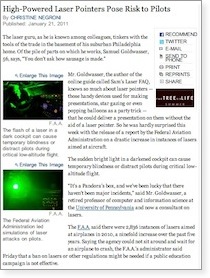
From the New York Times. Readers of the Times article may also be interested in clarifications, tips and links compiled by LaserPointerSafety.com.
US: Orlando Sentinel runs article on laser hazards
The Orlando Sentinel has run a story entitled “Lasers causing havoc for pilots in record numbers.” The story discusses FAA laser incident statistics nationally, as well as for Florida and the Orlando area. The author, Gary Taylor, also discusses Orlando area incidents such as these.
From the Orlando Sentinel
From the Orlando Sentinel
Russia: Jail proposed for laser "hooligans"; media asked to not report incidents
The United Russia party has introduced legislation calling for 10-year jail terms for laser “hooligans”. The bill was sent to the lower house of the Russian Parliament, the State Duma. It is unclear from news reports whether the legislation’s 10-year penalty is simply for aiming at or illuminating an aircraft, or if it is for cases that result in deaths.
The Moscow Times said Rostov-on-Don’s police chief wanted a 10-year term for people who blind pilots if their actions result in deaths. Alexi Lapin also blamed media attention for encouraging copycats: “Publicity in the media only encourages them to act. In medicine, this is called an epidemic, and it has yet to peak.”
Others agreed with the police chief’s media theory, including the leader of Chechnya, Ramzan Kadyrov, who banned laser pointer sales (and by some media accounts, possession) on July 4 2011. A senior Transportation Ministry official asked media to stop covering the incidents: "Judging by the European experience, the less information there is on the issue, the fewer cases"
The attention comes after more than 50 reports of “laser hooliganism” thus far this year in Russia. This compares with five incidents in all of 2010.
From RIA Novosti., the Moscow Times and Bloomberg. See also other LaserPointerSafety.com stories about Russian aviation incidents and laser statistics.
The Moscow Times said Rostov-on-Don’s police chief wanted a 10-year term for people who blind pilots if their actions result in deaths. Alexi Lapin also blamed media attention for encouraging copycats: “Publicity in the media only encourages them to act. In medicine, this is called an epidemic, and it has yet to peak.”
Others agreed with the police chief’s media theory, including the leader of Chechnya, Ramzan Kadyrov, who banned laser pointer sales (and by some media accounts, possession) on July 4 2011. A senior Transportation Ministry official asked media to stop covering the incidents: "Judging by the European experience, the less information there is on the issue, the fewer cases"
The attention comes after more than 50 reports of “laser hooliganism” thus far this year in Russia. This compares with five incidents in all of 2010.
From RIA Novosti., the Moscow Times and Bloomberg. See also other LaserPointerSafety.com stories about Russian aviation incidents and laser statistics.